


You may also like
-
Voyage autour du monde Pl.016 Poster
Louis-Isidore Duperrey · 1825 · Impression scientifique colorée à la main montrant poissons au trait précis et teintes marines
Poster dès €9 · Encadré dès €16
Prix habituel À partir de €6,00Prix habituel -
Voyage autour du monde 17 Poster
Louis-Isidore Duperrey · 1825 · Impression scientifique détaillée d'études de poissons du Pacifique au trait net et à la colorisation douce
Poster dès €9 · Encadré dès €16
Prix habituel À partir de €6,00Prix habituel -
Voyage autour du monde Pl.008 Poster
Louis-Isidore Duperrey · 1825 · Impression scientifique détaillée de requin en profil avec ombrages précis et annotations
Poster dès €9 · Encadré dès €16
Prix habituel À partir de €6,00Prix habituel -
Voyage autour du monde 56 Poster
Louis-Isidore Duperrey · 1825 · Délicate impression de coquillages disposée comme une planche scientifique aux tons côtiers chauds
Poster dès €9 · Encadré dès €16
Prix habituel À partir de €6,00Prix habituel


-

'Très beaux posters. La qualité est incroyable et nous les avons reçus très vite !'
-

'Une boutique incontournable. Un choix énorme de posters. On y a passé plus d'une heure !'
-

'Parfait pour trouver un cadeau. Les prix sont très corrects. Et ils peuvent l'encadrer et l'emballer sur place'
À propos de l'artiste
Louis-Isidore Duperrey était officier de marine français, explorateur et hydrographe dont les voyages au début du XIXe siècle ont enrichi la connaissance européenne des océans. Chef d'une circumnavigation mondiale achevée en 1825, Duperrey a collaboré étroitement avec des naturalistes pour documenter la faune marine, contribuant à l'essor de l'illustration scientifique et de la classification zoologique de son époque.
Cette impression vintage témoigne d'une période où les rapports d'expédition se transformaient en archives visuelles, convertissant des observations de terrain en ouvrages de référence durables pour savants et collectionneurs d'art classique et d'histoire maritime.
L'œuvre
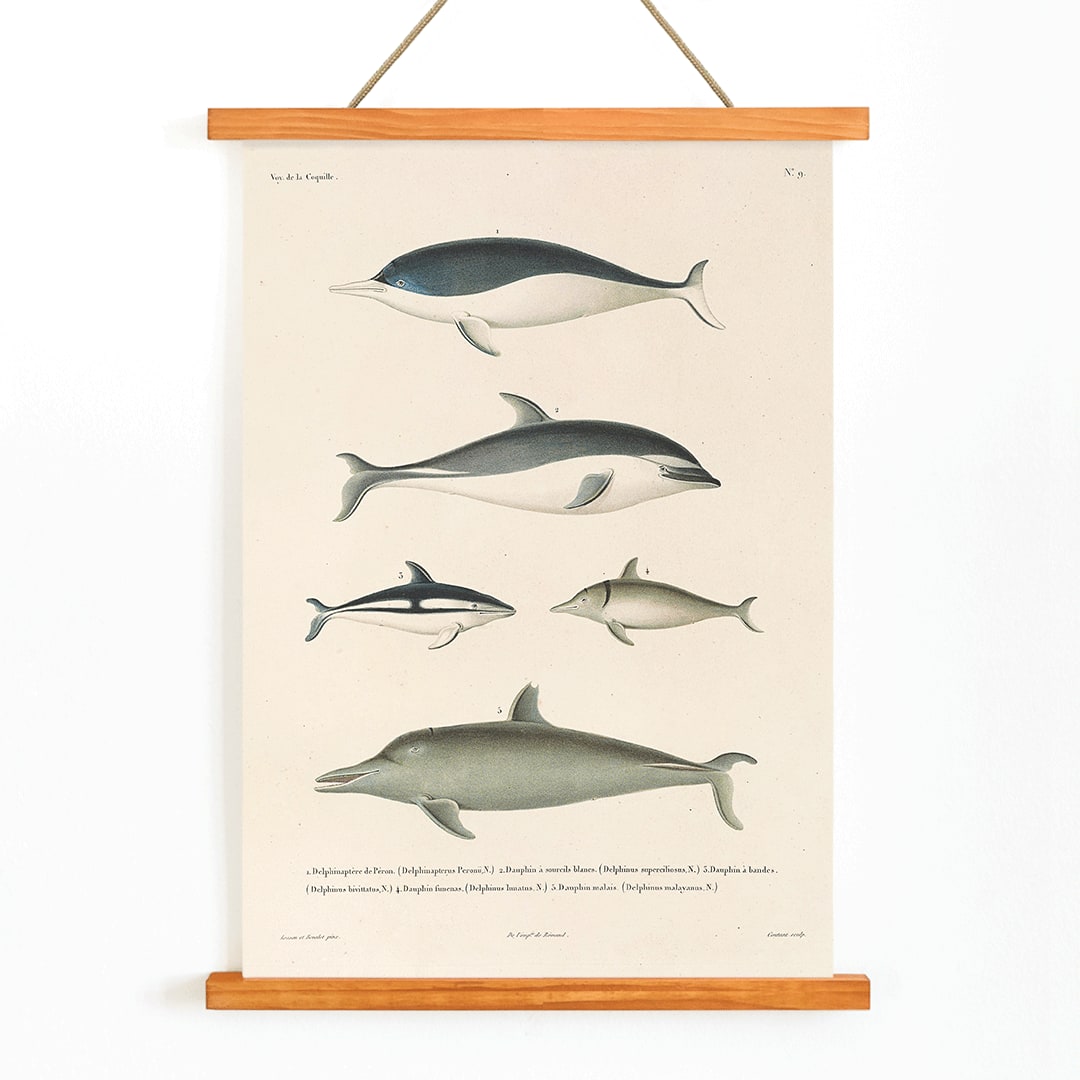
Cette planche s'inscrit dans la tradition des voyages scientifiques du début des années 1800, lorsque les explorateurs consignaient avec soin les nouvelles espèces rencontrées lors de leurs périples. Dans le cadre de l'expédition de Duperrey, les dauphins faisaient l'objet d'études tant comme merveilles naturelles que comme sujets pour les systèmes zoologiques émergents. L'illustration fait partie d'un atlas conçu pour diffuser les connaissances recueillies, faisant le lien entre travail de terrain et étude académique.
Son objectif était de fournir une référence visuelle fiable aux scientifiques et aux amateurs, reflétant l'esprit de découverte et la volonté de cataloguer le monde naturel. Aujourd'hui, elle demeure un document historique qui relie le spectateur à l'âge des explorations et à la curiosité scientifique.
Style et caractéristiques
La planche adopte la mise en page classique de l'histoire naturelle, présentant plusieurs études de dauphins espacées pour faciliter la comparaison. L'artiste utilise un tracé précis et un ombrage subtil pour rendre les détails anatomiques, conférant à l'image à la fois clarté et raffinement. La palette est sobre, mêlant bleu doux, gris frais et le beige chaud du papier jauni, qui ensemble évoquent une atmosphère calme et d'archives.
Cette impression scientifique équilibre rigueur et élégance, incarnant l'approche érudite de l'art d'expédition du XIXe siècle. Sa composition sereine et ses couleurs atténuées la rendent attrayante visuellement tout en conservant sa fonction d'enregistrement d'observation.
Dans la décoration intérieure
Cette impression scientifique s'intègre idéalement aux intérieurs d'inspiration côtière, aux chambres reposantes ou aux bureaux lumineux où l'on souhaite un point focal discret. Elle s'accorde joliment avec les bois clairs, les tissus en lin et les accents en métal brossé, et se fond naturellement dans une décoration sur le thème de la mer sans paraître trop thématique grâce à son ton historique subtil.
Pour renforcer son effet, pensez à faire écho au ton beige du papier avec des murs neutres ou un encadrement en chêne, et à souligner les nuances bleu-gris par des céramiques ou textiles. Cette impression vintage apporte une touche de charme historique aux amateurs de décoration inspirée par la nature et la science.