


You may also like
-

Crâne humain Poster
Institut de Leipzig · 1924 · Impression scientifique détaillée de profils et vue de la base du crâne
Poster dès €9 · Encadré dès €16
-

Squelette humain Poster
Institute of Liepzig · 1900 · Impression scientifique détaillée du squelette humain au trait net sur papier beige chaud
Poster dès €9 · Encadré dès €16
-

Système sanguin humain Poster
Institute of Leipzig · 1906 · Affiche anatomique détaillée de la circulation sanguine avec vaisseaux rouges et bleus sur beige
Poster dès €9 · Encadré dès €16
-

Planiglobes de la Terre I Poster
Institute of Liepzig · 1860 · Carte du monde hémisphérique détaillée en impression vintage avec graticules nets et typographie ancienne
Poster dès €9 · Encadré dès €16


-

'Très beaux posters. La qualité est incroyable et nous les avons reçus très vite !'
-

'Une boutique incontournable. Un choix énorme de posters. On y a passé plus d'une heure !'
-

'Parfait pour trouver un cadeau. Les prix sont très corrects. Et ils peuvent l'encadrer et l'emballer sur place'
À propos de l'artiste
Institute of Liepzig a fait partie d'une vague d'institutions académiques allemandes du XIXe siècle qui ont fait progresser l'enseignement médical grâce à des supports visuels détaillés. En 1869, ces planches anatomiques imprimées sont devenues des outils indispensables dans les amphithéâtres et les laboratoires, soutenant le développement rapide de la neurologie comme discipline scientifique. Ces images étaient conçues pour standardiser les connaissances et faciliter la communication entre étudiants et professionnels à travers l'Europe.
Aujourd'hui, cette œuvre est prisée par les collectionneurs d'art scientifique et par ceux qui s'intéressent à l'histoire de l'illustration médicale. En tant que poster cerveau humain vintage, elle reflète la quête d'exactitude et de clarté propre à l'époque dans les supports pédagogiques scientifiques.
L'œuvre
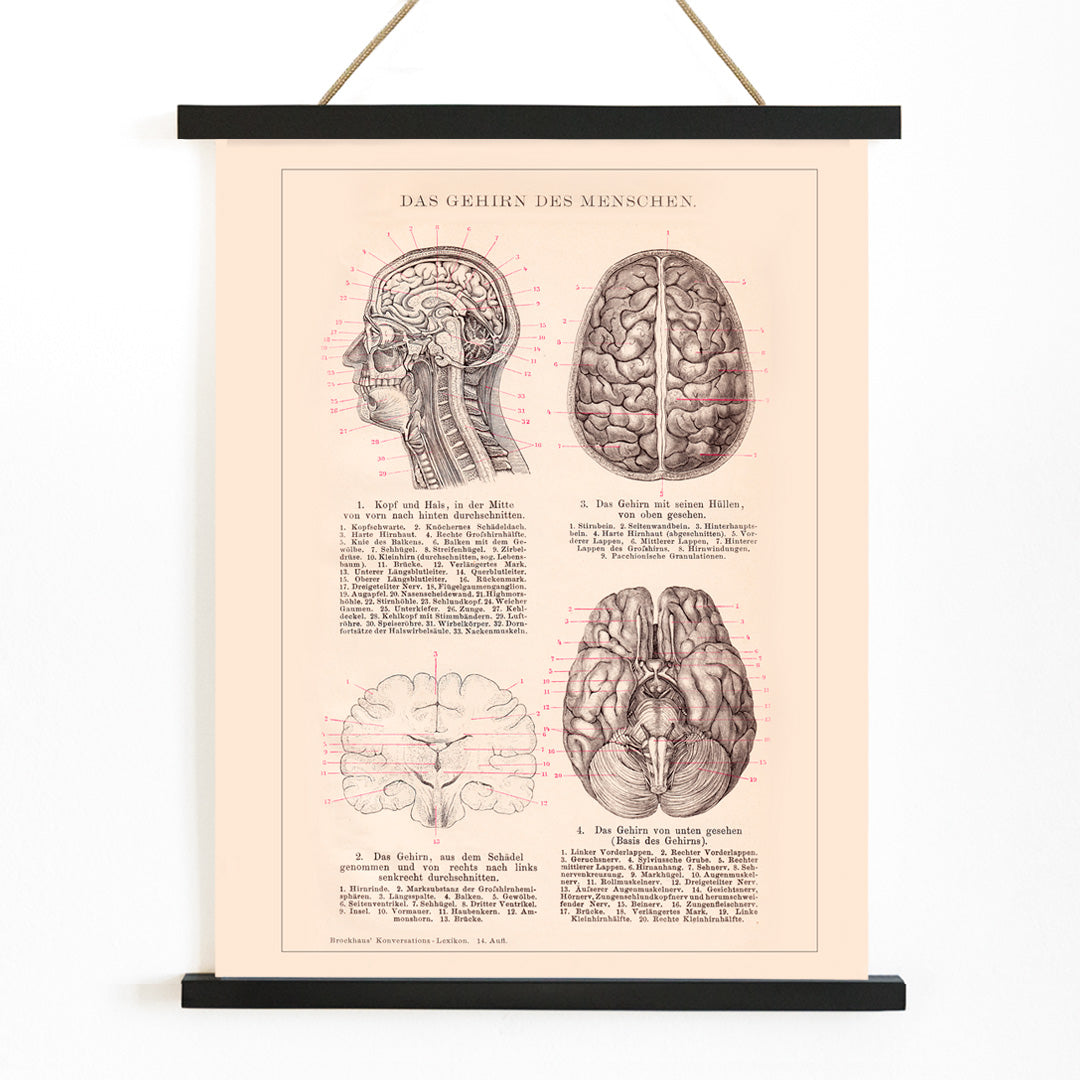
Cette étude anatomique du cerveau humain a été réalisée à une période où la science médicale tendait vers une plus grande spécialisation et précision. L'illustration servait de référence aux étudiants et praticiens, aidant à établir une terminologie cohérente et à approfondir la compréhension de la structure et du fonctionnement cérébral. Sa finalité était à la fois éducative et archivistique, capturant un moment où les mystères de l'esprit étaient cartographiés avec une nouvelle rigueur.
Le sujet marque aussi un tournant dans l'histoire intellectuelle, le cerveau devenant central aux conceptions de la mémoire, de la perception et de la cognition. Ce poster scientifique demeure le témoignage de l'attrait de l'époque pour le déchiffrement des complexités de la pensée humaine.
Style et caractéristiques
La composition s'organise comme une planche pédagogique classique, le cerveau étant dessiné en traits noirs fins et ombrages subtils pour souligner le détail anatomique. La forme est isolée sur un fond beige chaud, garantissant lisibilité et concentration sur le sujet. Petites légendes et annotations identifient des régions spécifiques, conférant à l'image un aspect archivistique et savant.
La palette mesurée de beige et noir, ainsi que le dessin précis, crée une atmosphère calme et studieuse. L'effet global est une autorité discrète, faisant de cette impression scientifique un ajout raffiné à tout espace intellectuel.
Dans la décoration intérieure
Ce poster anatomique convient particulièrement aux bureaux, bibliothèques, ateliers ou couloirs où l'on apprécie une décoration raisonnée. Son style épuré se marie aux intérieurs minimalistes, industriels ou classiques, et se combine naturellement avec le bois, le cuir ou les métaux mats.
Pour un ensemble cohérent, associez-le à des œuvres beige ou créez un contraste avec des impressions noir et blanc. Sa présence érudite séduit les professionnels de la médecine, les étudiants et toute personne souhaitant composer un espace moderne ancré dans la connaissance et l'histoire.