


You may also like
-

Composition Poster
Georges Valmier · 1921 · Impression d'art abstraite dynamique d'éléments imbriqués et de blocs de couleurs vives en mouvement
Poster dès €9 · Encadré dès €16
-

11 tableaux et 7 poèmes Poster
Wassily Kandinsky · 1945 · Poster géométrique rythmique équilibrant formes primaires vives et typographie moderniste raffinée
Poster dès €9 · Encadré dès €16
-

Komposition Poster
Otto Freundlich · 1936 · Vibrante impression d'art géométrique aux plans colorés imbriqués et énergie moderniste
Poster dès €9 · Encadré dès €16
-

Composition Abstraite Poster
Otto Freundlich · 1937 · Vibrante impression d'art géométrique de blocs de couleur imbriqués bordés de noir
Poster dès €9 · Encadré dès €16


-

'Très beaux posters. La qualité est incroyable et nous les avons reçus très vite !'
-

'Une boutique incontournable. Un choix énorme de posters. On y a passé plus d'une heure !'
-

'Parfait pour trouver un cadeau. Les prix sont très corrects. Et ils peuvent l'encadrer et l'emballer sur place'
À propos de l'artiste
Franz Wilhelm Seiwert était un peintre et graphiste allemand, reconnu comme une figure centrale des Cologne Progressives au début de la République de Weimar. Son travail naît d'une période de profondes transformations sociales et politiques, où les artistes cherchaient à redéfinir la place de l'art dans la vie publique. L'approche de Seiwert s'est construite autour d'un engagement pour la clarté et l'implication sociale, utilisant des formes géométriques pour communiquer des enjeux collectifs plutôt qu'individuels.
Actif au sein de cercles de modernisme politiquement engagé, Seiwert a contribué au développement d'idées proche du constructivisme et de la Neue Sachlichkeit dans le Rhin. Cette composition de 1920 illustre sa conviction que l'art doit servir de langage visuel aux questions sociétales, attirant l'attention des collectionneurs intéressés par les artistes modernes influents et les mouvements de design du début du XXe siècle.
L'œuvre
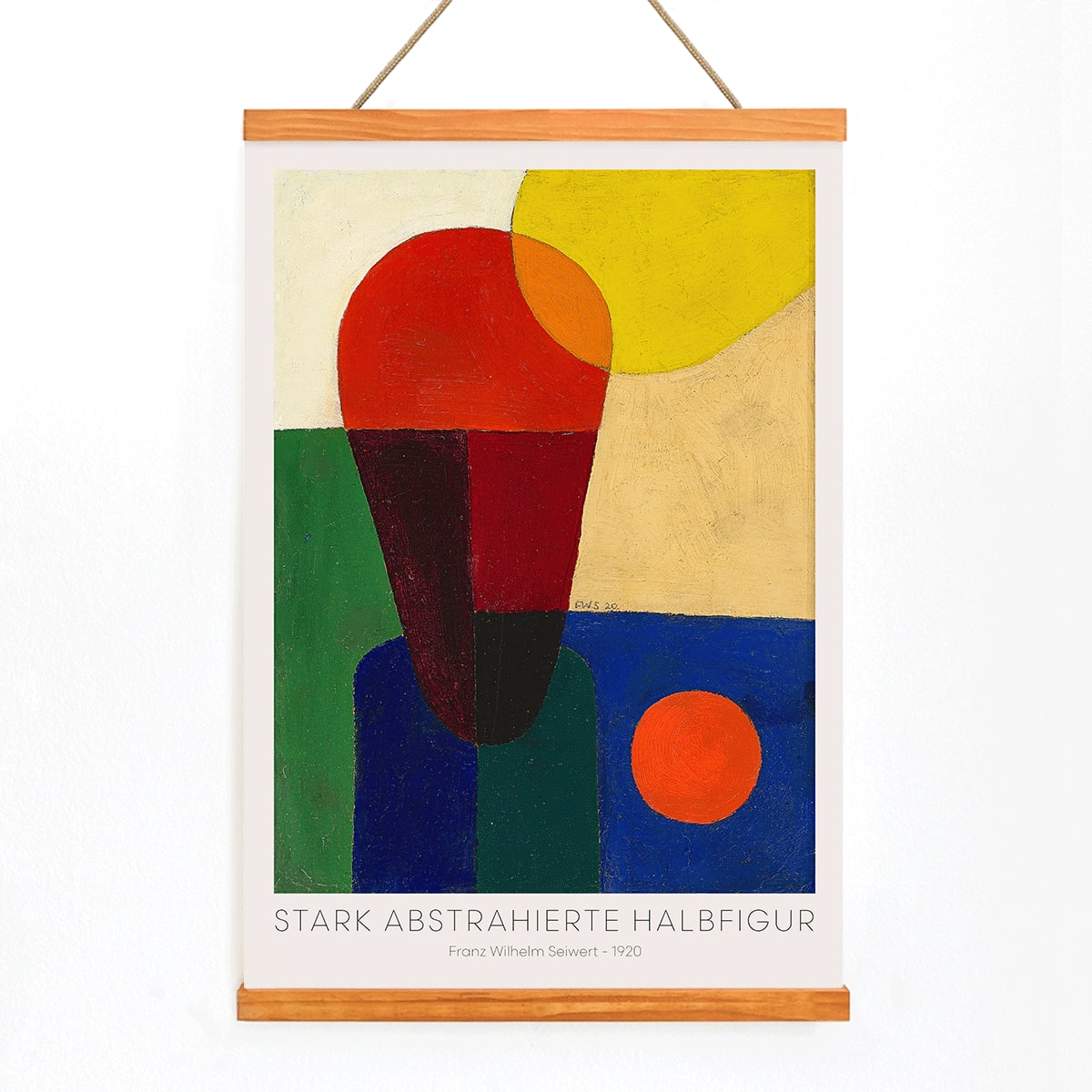
Demi-figure fortement abstraite a été créée à une époque où les artistes européens repensaient la représentation du corps humain après la Première Guerre mondiale. Plutôt que de dépeindre un individu spécifique, Seiwert réduit la forme humaine à un symbole universel, privilégiant la structure sur la personnalité. Cette réduction est à la fois un choix stylistique et une déclaration visant à rendre l'art plus accessible et pertinent pour la société dans son ensemble.
Dans le contexte des Cologne Progressives, une telle abstraction visait à favoriser une communication directe et une conscience sociale. En reproduction de poster vintage, l'œuvre transmet l'esprit des débats modernistes autour du travail, de la communauté et du progrès, établissant un lien entre les idéaux du passé et les espaces contemporains.
Style et caractéristiques
L'image présente une demi-figure fortement stylisée, construite à partir de formes géométriques imbriquées. Des zones vives de rouge, jaune, vert, bleu et blanc sont délimitées par des contours sombres, produisant un contraste marqué et une impression de solidité architecturale. La composition, compacte et frontale, utilise des diagonales dynamiques et des volumes stables qui lui confèrent une humeur volontaire et énergique.
Ce langage visuel évoque des influences constructivistes et du Bauhaus, perceptibles dans notre sélection de art mural inspiré du Bauhaus. L'agencement précis des formes et des couleurs rend l'impression remarquable à distance comme au plus près, récompensant l'observateur par des relations formelles nettes et une clarté moderniste.
Dans la décoration intérieure
Ce poster moderniste convient aux salons, bureaux ou ateliers créatifs où des formes géométriques fortes servent de point focal. Ses couleurs primaires et sa composition abstraite s'associent naturellement à un mobilier minimaliste ou mid-century, ainsi qu'à des espaces jouant le contraste graphique ou le color-blocking.
Pour un ensemble harmonieux, reprenez une ou deux teintes de l'œuvre dans les textiles ou accessoires et conservez des murs neutres pour l'équilibre. Un cadre noir simple ou en bois naturel renforce l'intention moderniste ; consultez notre collection de cadres pour une finition raffinée.