


You may also like
-

The November meteors Poster
Étienne Léopold Trouvelot · 1882 · Luminous meteor-shower scientific print streaking across a deep night sky
Poster from €9 · Framed from €16
-

The zodical light Poster
Étienne Léopold Trouvelot · 1882 · Luminous night-sky scientific print showing a slanted zodiacal glow above a dark horizon
Poster from €9 · Framed from €16
-

Part of the milky way Poster
Étienne Léopold Trouvelot · 1882 · Atmospheric Milky Way scientific print showing dense star clouds and dark interstellar lanes
Poster from €9 · Framed from €16
-

Le Ciel Poster
Alphonse Berget · 1925 · Art Nouveau astronomy poster featuring a deep blue sky with celestial diagrams
Poster from €9 · Framed from €16


-

"Very nice Posters. The quality is amazing and we received it very quickly !"
-

"A shop to visit absolutely. Huge selection of posters. We spent more than an hour there !"
-

"Perfect to find gift. Price are very good. An they can frame and pack it on site"
About the Artist
Étienne Léopold Trouvelot was a French-born astronomer and artist who made his mark in the United States during the late nineteenth century, a period marked by growing fascination with astronomy. Working at institutions such as the Harvard College Observatory, Trouvelot became renowned for his ability to translate meticulous telescope observations into accessible visual works for both experts and the general public.
His astronomical illustrations were later published as chromolithographs, elegantly merging scientific precision with artistic sensibility. Trouvelot’s legacy endures among enthusiasts of science themed wall art for his unique ability to render the mysteries of the cosmos with both clarity and poetic resonance.
The Artwork
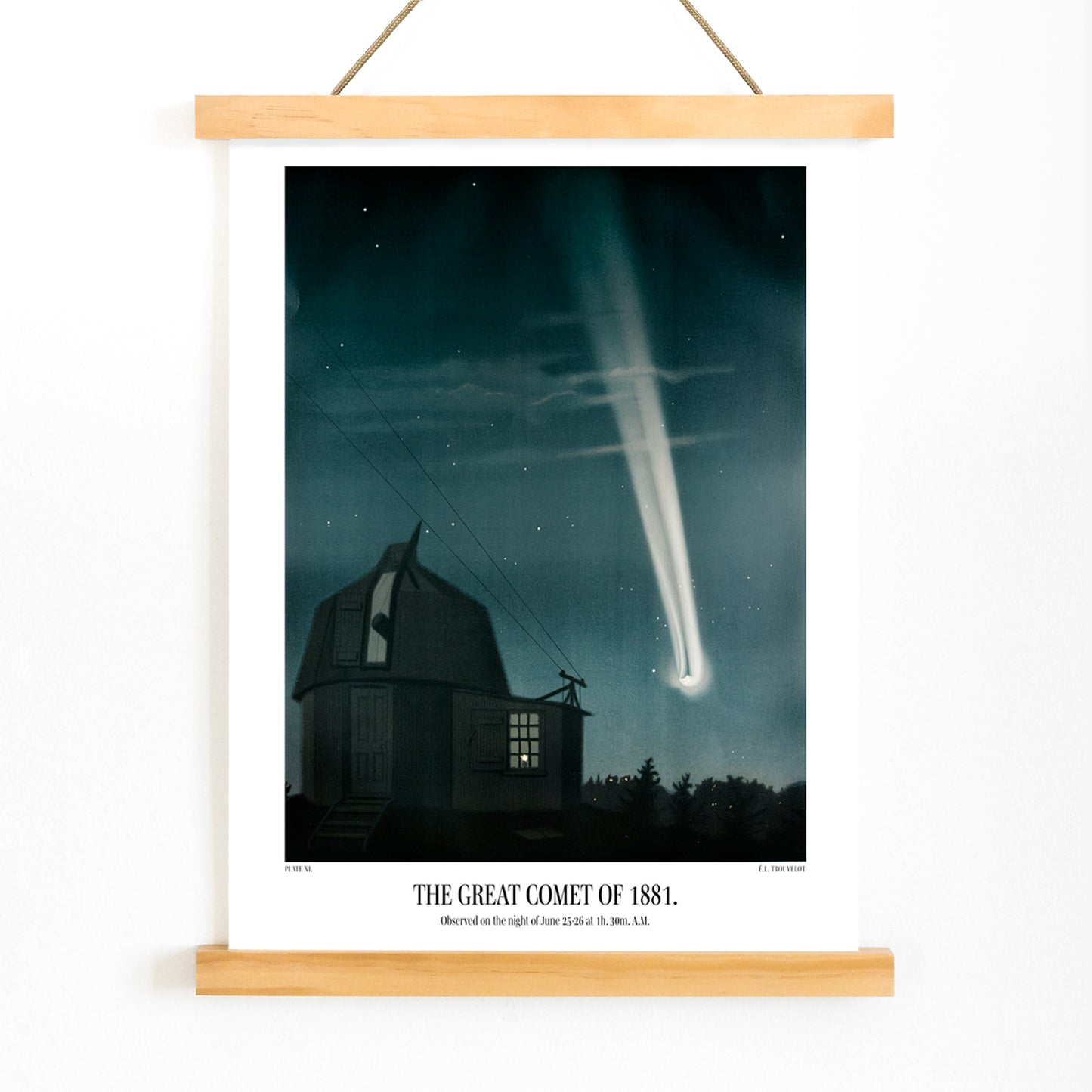
This 1881 illustration captures the appearance of a brilliant comet as it traversed the night sky, a spectacle that captivated both scientists and the wider public. In an era when comets were still enigmatic, each new sighting contributed to evolving theories about celestial mechanics and the nature of the solar system.
Trouvelot created this work to document what could be observed through a telescope at a time when photographic technology was not yet able to capture such faint, detailed phenomena. The image evokes the spirit of nineteenth-century public lectures and illustrated atlases that brought astronomy into everyday life, inspiring curiosity and wonder.
Style & Characteristics
The artwork features a luminous comet with a long, sweeping tail set against a richly detailed field of stars. Deep indigo and near-black hues dominate the composition, while soft whites and pale highlights convey the comet’s radiant glow and the vastness of space.
Trouvelot’s precise rendering and subtle gradations of tone give the print a sense of scientific observation, rather than mere decoration. The mood is contemplative and expansive, characteristic of nineteenth-century astronomical illustration and well suited to space art prints.
In Interior Design
This piece serves as a striking focal point in studies, reading corners, or modern living spaces where a sense of calm and contemplation is desired. Its dark palette and luminous accents pair beautifully with minimalist interiors, mid-century furnishings, and gallery walls that combine photography, diagrams, and classic prints.
Consider framing it in matte black or natural oak for a refined finish, and complementing it with blue tone prints to extend its nocturnal ambiance throughout your space.