


You may also like
-
The zodical light Poster
Étienne Léopold Trouvelot · 1882 · Luminous night-sky scientific print showing a slanted zodiacal glow above a dark horizon
Poster from €9 · Framed from €16
Regular price From €6,00Regular price -
The November meteors Poster
Étienne Léopold Trouvelot · 1882 · Luminous meteor-shower scientific print streaking across a deep night sky
Poster from €9 · Framed from €16
Regular price From €6,00Regular price -
The great comet of 1881 Poster
Étienne Léopold Trouvelot · 1881 · Luminous comet scientific print sweeping through a star filled night sky in deep indigo
Poster from €9 · Framed from €16
Regular price From €6,00Regular price -
Southern Sky Star Poster Poster
The Institute of Leipzig · 1854 · Detailed southern sky print featuring crisp star points and fine constellation lines
Poster from €9 · Framed from €16
Regular price From €6,00Regular price


-

"Very nice Posters. The quality is amazing and we received it very quickly !"
-

"A shop to visit absolutely. Huge selection of posters. We spent more than an hour there !"
-

"Perfect to find gift. Price are very good. An they can frame and pack it on site"
About the Artist
Étienne Léopold Trouvelot was a French-born astronomer and artist who emigrated to the United States in the mid-19th century. Working at Harvard College Observatory, he became renowned for his ability to translate astronomical observations into detailed and evocative illustrations at a time when photography could not capture the night sky’s subtleties.
Trouvelot’s work bridged the gap between scientific documentation and artistic expression, making the wonders of astronomy accessible to a wider audience. His prints were widely published and collected, inspiring both amateur astronomers and art lovers. Discover more in our science and space collections.
The Artwork
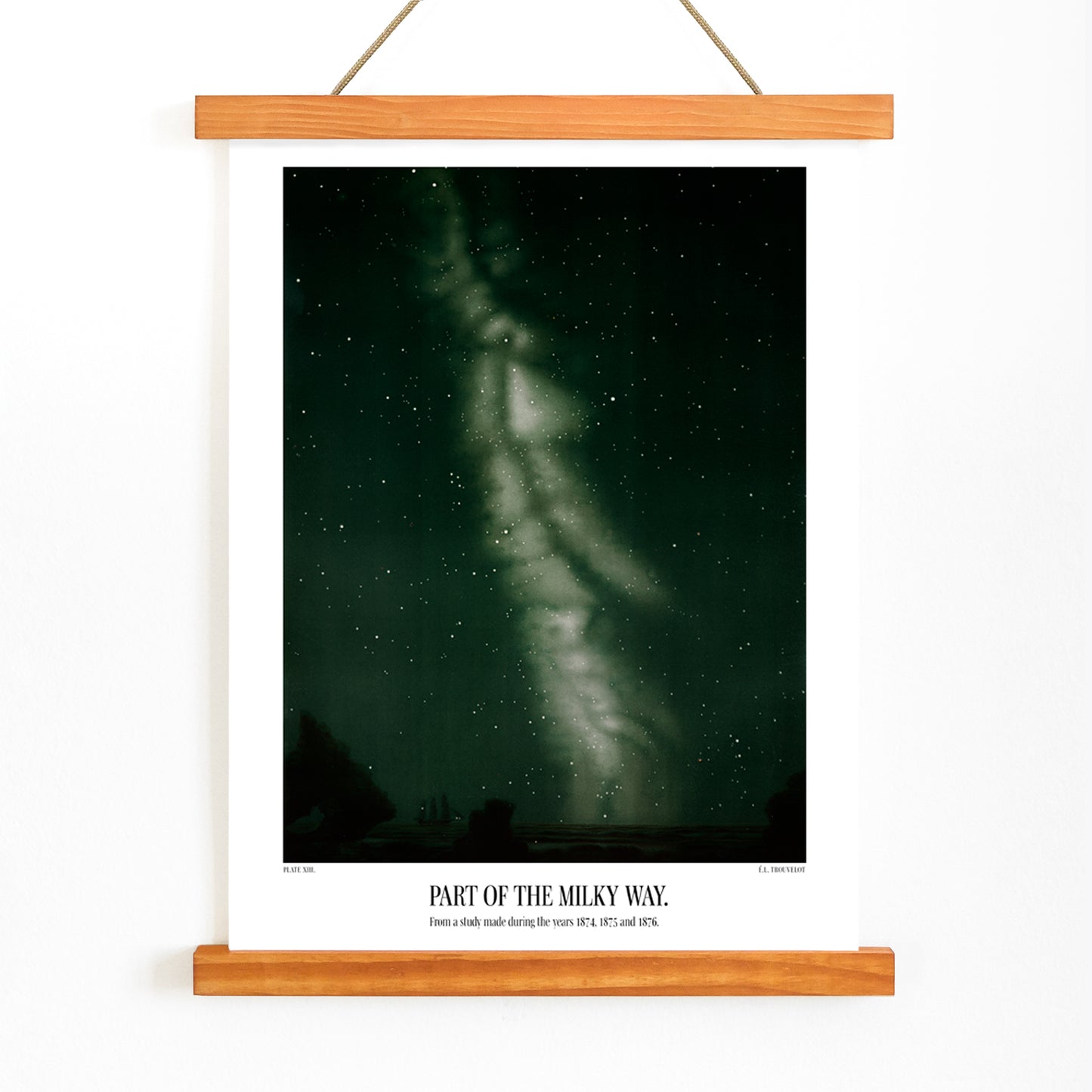
This depiction of the Milky Way is part of Trouvelot’s celebrated series of astronomical plates from the 1880s, created to share the awe of celestial phenomena with the public. At a time of growing interest in astronomy, these works served as both educational tools and sources of inspiration, inviting viewers to contemplate the vastness of the universe.
Rather than mapping specific constellations, Trouvelot focused here on the Milky Way’s dense star fields as seen through a telescope, emphasizing the galaxy’s structure and the mystery of deep space. Such prints played a role in fostering curiosity and wonder about the cosmos.
Style & Characteristics
The composition presents a sweeping view of the night sky, filled with countless stars scattered across a dark background. Dense clusters form a luminous, cloud-like band, while subtle gradations of tone create a sense of depth and movement.
Executed in black and white with a faint suggestion of cool green in the hazy regions, the print conveys a tranquil, immersive mood. The crisp points of starlight contrast with softer, misty areas, capturing the Milky Way’s ethereal beauty. This restrained palette and contemplative atmosphere make it a striking choice for lovers of vintage scientific art.
In Interior Design
This scientific print lends a sense of calm and intellectual curiosity to bedrooms, studies, or hallways. Its understated palette complements minimalist, modern, or classic interiors, adding visual interest without overpowering the space.
Pair it with charcoal, off-white, or muted green accents, or introduce warmth with wood and brass details. A slim black or natural wood frame enhances its gallery appeal; explore options in our frames collection. It also works beautifully as part of a curated gallery wall with maps and other monochrome art.