


You may also like
-
Transparent Solar System Poster
James Reynolds · 1851 · Detailed solar system scientific print with labeled orbits and hand-tinted planetary accents
Poster from €9 · Framed from €16
Regular price From €6,00Regular price -
Diagram of Meteorology Poster
James Reynolds · 1846 · Detailed meteorology poster mapping winds and cloud forms in hand-colored diagrams
Poster from €9 · Framed from €16
Regular price From €6,00Regular price -
Transparent Chart of the Heavens Poster
James Reynolds · 1850 · Ingenious celestial map poster featuring a rotating sky chart with labeled constellations
Poster from €9 · Framed from €16
Regular price From €6,00Regular price -
Appearance of the Moon Poster
James Reynolds · 1850 · Detailed lunar scientific print showing cratered surface in delicate black on beige
Poster from €9 · Framed from €16
Regular price From €6,00Regular price


-

"Very nice Posters. The quality is amazing and we received it very quickly !"
-

"A shop to visit absolutely. Huge selection of posters. We spent more than an hour there !"
-

"Perfect to find gift. Price are very good. An they can frame and pack it on site"
About the Artist
James Reynolds was a prominent figure in the world of mid-19th century educational illustration, a time when scientific advances demanded clear and accessible visual explanations. His work is known for its clarity, precision, and the ability to communicate complex ideas through carefully labeled diagrams. Reynolds contributed to a tradition where illustration served as a bridge between scientific discovery and public understanding, supporting both formal education and practical workshop use.
His illustrations, often commissioned by publishers and educators, became essential tools for teaching and for the dissemination of new scientific knowledge. This legacy places Reynolds among the key contributors to the visual culture of Victorian science.
The Artwork
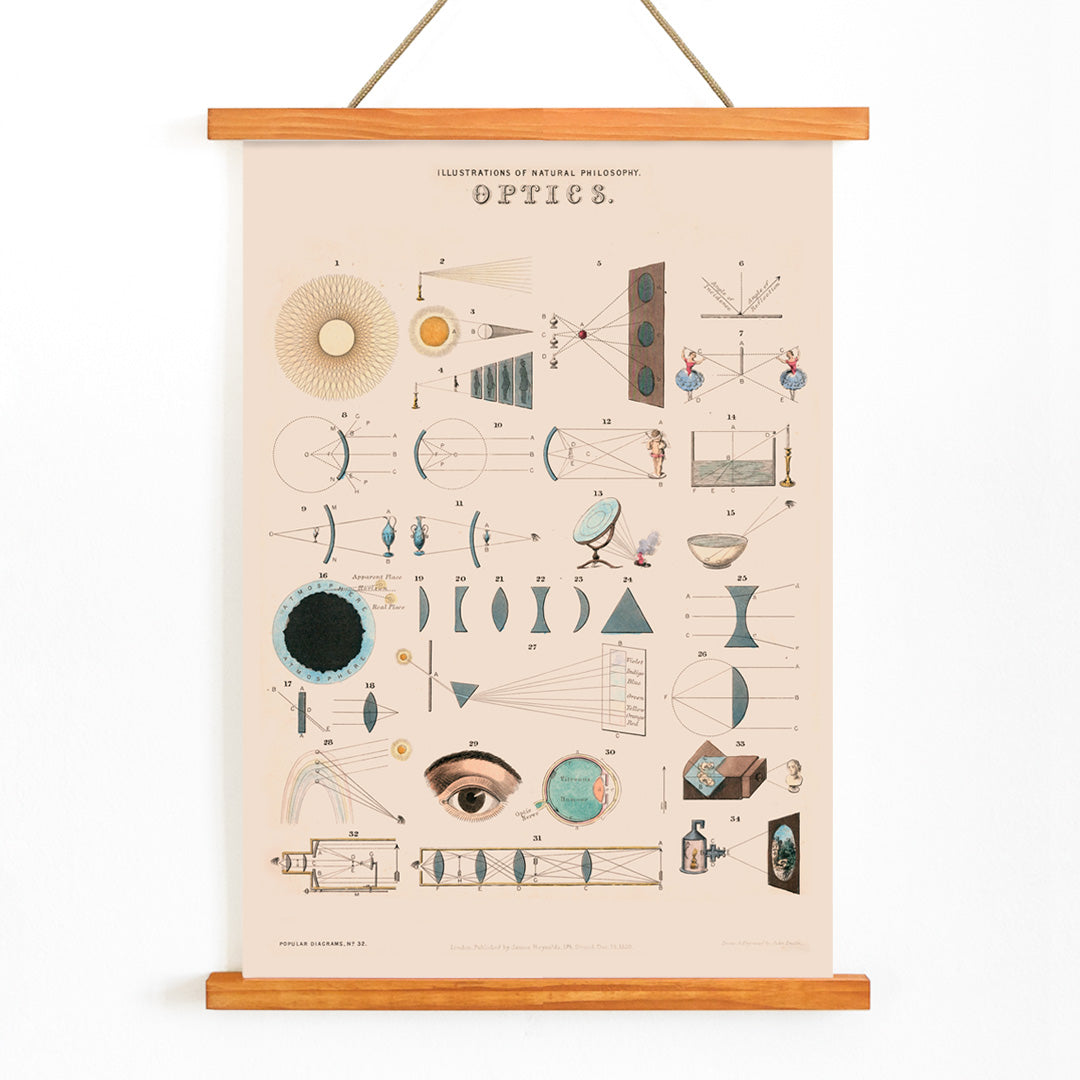
Created in 1850, View of lenses emerged during a period of rapid innovation in optics, when new lens designs were transforming fields such as microscopy, astronomy, and photography. This print was intended as a reference for students, teachers, and instrument makers, providing a shared visual vocabulary for understanding the properties and applications of different lenses.
By translating technical concepts into a clear visual format, the artwork reflects the era’s drive for scientific literacy and practical knowledge. It stands as a testament to the importance of accessible educational resources in the advancement of science.
Style & Characteristics
The composition is organized as a scientific study plate, displaying a series of lens diagrams in a logical, systematic arrangement. Each lens is rendered with fine black linework, emphasizing technical accuracy and clarity over decorative embellishment. The background features a warm beige tone, evoking the look of aged paper, while subtle blue and brown accents add gentle depth to the otherwise monochrome palette.
The overall mood is calm, precise, and intellectually engaging, making it especially appealing to collectors of science illustrations and black and white wall art. The restrained color scheme and meticulous detail underscore its origins as a practical educational tool.
In Interior Design
This optics print lends a thoughtful, scholarly character to home offices, libraries, studios, or hallways where curiosity and learning are valued. It pairs well with wood, leather, and brass, as well as minimalist modern furnishings, creating a bridge between vintage and contemporary styles.
For a harmonious gallery wall, combine it with beige toned prints and introduce blue accents through ceramics or textiles. Its understated elegance makes it a fitting choice for photographers, engineers, or anyone drawn to knowledge-inspired decor.