




-

"Very nice Posters. The quality is amazing and we received it very quickly !"
-
"A shop to visit absolutely. Huge selection of posters. We spent more than an hour there !"
-

"Perfect to find gift. Price are very good. An they can frame and pack it on site"
About the Artist
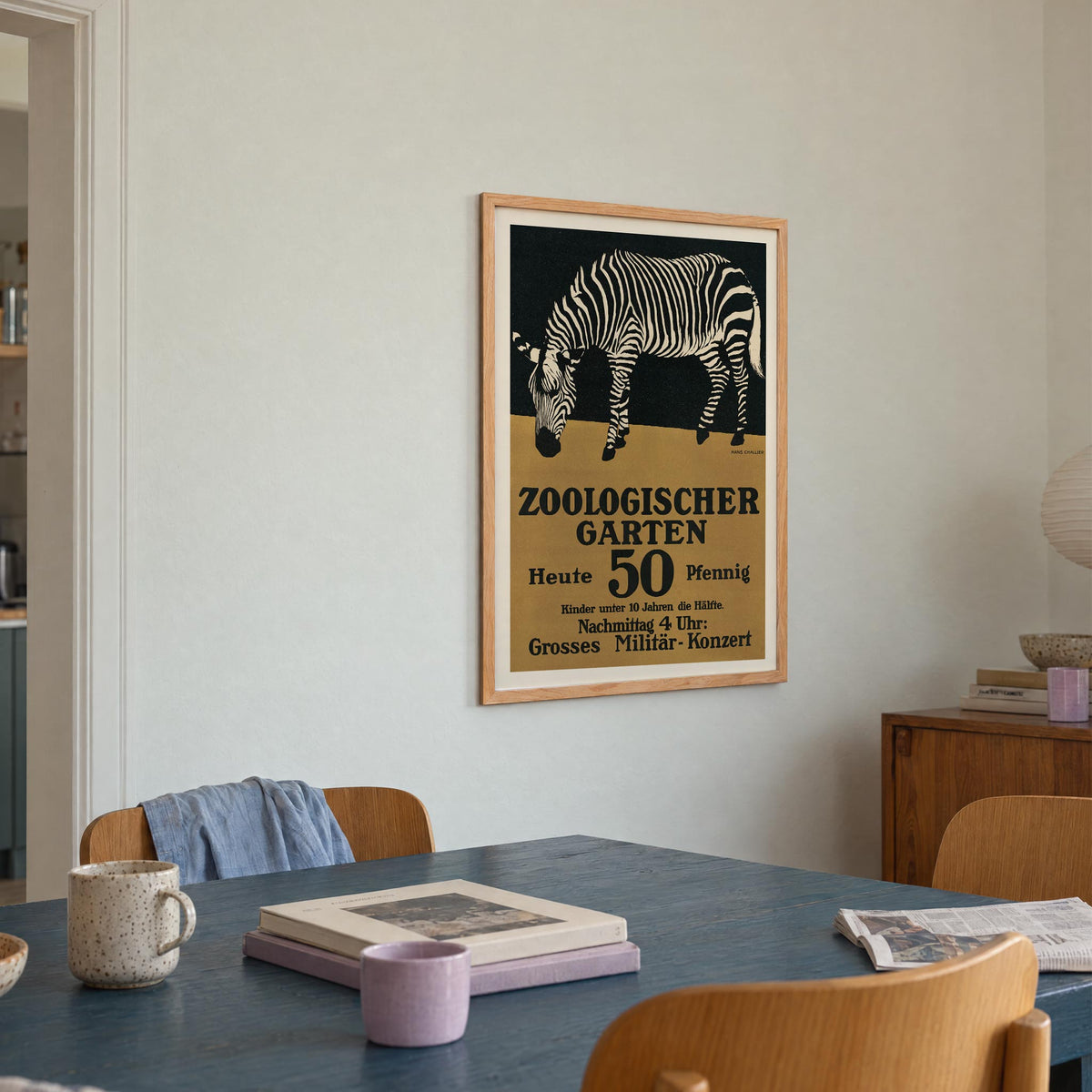
Karl Schnebel makes a zebra the invitation to an afternoon at the Zoologischer Garten in this 1903 vintage poster. His name appears beside the animal, connecting the advertisement to its maker without distracting from the promised outing. The commission introduces Schnebel through a practical task: persuading visitors to buy admission to a zoo that also offered live music. This vintage print records a particular commercial encounter between animal imagery and public entertainment. Its Belle Époque setting emerges through the advertised military concert, a scheduled attraction that gave visitors another reason to spend the afternoon there.
The Artwork
Fifty Pfennig bought admission, while the same notice promised music later in the day. Children under ten paid half, and the advertised Grosses Militär-Konzert began at four in the afternoon. A zoo visit and a musical programme therefore shared one invitation. This 1900s zoo advertising poster preserves that meeting of nature and organised leisure without needing to explain it to its original audience. For a present-day viewer, the precise prices and time turn a general idea of historic recreation into a specific occasion, complete with the information a visitor needed to plan an outing.
Style & Characteristics
The zebra lowers its head across the boundary between a nearly black background and an ochre panel. Cream stripes bend around its broad torso before narrowing along the legs, drawing the eye down towards the German lettering. Small pale shapes beside the head punctuate the darkness. Below, ZOOLOGISCHER GARTEN spreads across two lines of heavy capitals, while the enormous 50 dominates the admission notice. Smaller text gathers beneath the numerals and finishes near the bottom edge. In this vintage zebra poster, the wavering stripes contrast with the dense letterforms, giving the animal more apparent movement than the text below.
In Interior Design
Imagine this vertical poster above a low oak cabinet in a study, opposite a dark reading chair. A narrow black frame would echo the background behind the zebra, while the ochre panel would bring warmth to the home decor without obscuring the wood grain below. Hung alone at seated eye level, the fine art print invites a pause between pages to read the concert announcement. For interior decoration centred on that single cabinet, the zebra supplies the main motif; the typography keeps the wall art connected to an actual afternoon of public entertainment in 1903.